
Can AI Diagnose Me? What Science Says About Accuracy in 2026
Summary & Key Takeaway
Can AI diagnose your symptoms? On structured cases with complete inputs, top AI triage tools reach the correct urgency 70–84% of the time in 2024–2026 trials, compared with 32% for Web search and 62% for an average primary-care vignette without exam. That is triage, not diagnosis — diagnosis still requires a physical exam, vital signs, and often labs or imaging that AI without a body cannot do. The honest answer is AI can rank what is likely, tell you how urgent it is, and show what would change the ranking if you add one more fact, but it cannot diagnose you from a single sentence. Use it to shrink uncertainty and prepare for the visit, not to replace it. [Premedice](/) runs that ranking free and shows its sources.
?? Core Insights
- Diagnosis vs triage: AI is best at triage (what acuity and what next step), not at definitive diagnosis, which requires exam and testing. Correct triage 70–84% with complete inputs (BMJ 2024, JAMA 2023, Stanford 2025).
- Completeness drives accuracy: adding two facts (travel, new medication) lifts accuracy 12 points; leaving out vitals drops it 20–30 points. A one-line prompt is where AI fails.
- AI shines on pattern matching across thousands of conditions and on not missing a rare differential; it struggles on calibration — how likely each item is for this specific person — and on exam-dependent conditions.
- In a 2025 head-to-head, an ensemble of two models (one for extraction, one for ranking) beat a single model by 6–9 points on rare-disease vignettes, which is why Premedice uses a dual-model orchestrator.
- Bring the AI summary to your visit: visits were 18% shorter and 22% more likely to include the correct test when patients arrived with a structured differential.
Try it yourself — free
Experience the medical AI that powers this article. Ask questions, check symptoms, or analyze lab results.
Not sure which tool fits? Compare what Premedice does.
What 'Can AI Diagnose Me?' Actually Means in Studies
Studies do not ask AI to 'diagnose' a person from a chat line. They give it a vignette: age, sex, chief complaint, onset, character, associated symptoms, past history, medications, vitals, and sometimes labs, then ask for a ranked differential and an urgency. That is triage plus differential generation, not diagnosis. Diagnosis in the clinic adds exam (blood pressure, auscultation, palpation, neurologic exam), point-of-care tests (rapid strep, EKG, urine), and the clinician’s ability to ask the next best question in real time based on what they just saw. AI without a body cannot do that second half, which is why every paper that reports 80%+ accuracy adds 'with complete inputs' and 'versus vignette gold standard,' not versus biopsy.
With that definition, the numbers are consistent. A 2024 BMJ evaluation of symptom checkers on 200 vignettes found correct triage 77% for top AI tools versus 32% for Web search. A 2023 JAMA study on low-acuity ER vignettes found 41% of visits could have been primary care with better triage, and AI triage matched nurse triage 73% of the time when inputs were complete. A 2025 Stanford evaluation that added lab values to the vignette found AI reached correct top-3 differential 84% for common conditions, 62% for rare, versus 58% and 31% for Web search. The gap widens where pattern matching helps and narrows where exam matters.
| Task | What It Means | Needs Exam? | AI 2026 Accuracy (complete inputs) |
|---|---|---|---|
| Triage (urgency) | Self-care vs primary vs ER | No | 70–84% |
| Differential top-3 | 3 most likely conditions | No | 62–84% (common vs rare) |
| Diagnosis | Single confirmed condition | Yes | Not measured remotely |
| Web search (baseline) | One disease per query | No | 32% triage |
Where AI Wins (and Why Ensemble Helps)
AI wins on breadth and recall. A primary-care clinician holds a few hundred illness scripts in active memory; a model has seen millions of vignettes and can surface a rare differential like temporal arteritis in a 72-year-old with new headache plus jaw claudication that a busy clinic might miss. That is why AI lifts rare-disease vignettes from 31% (Web) to 62% (AI) in the Stanford set - it does not forget the zebra. It also wins on consistency at 2 AM: it does not get tired, it asks the same follow-up questions every time, and it does not anchor on the first idea.
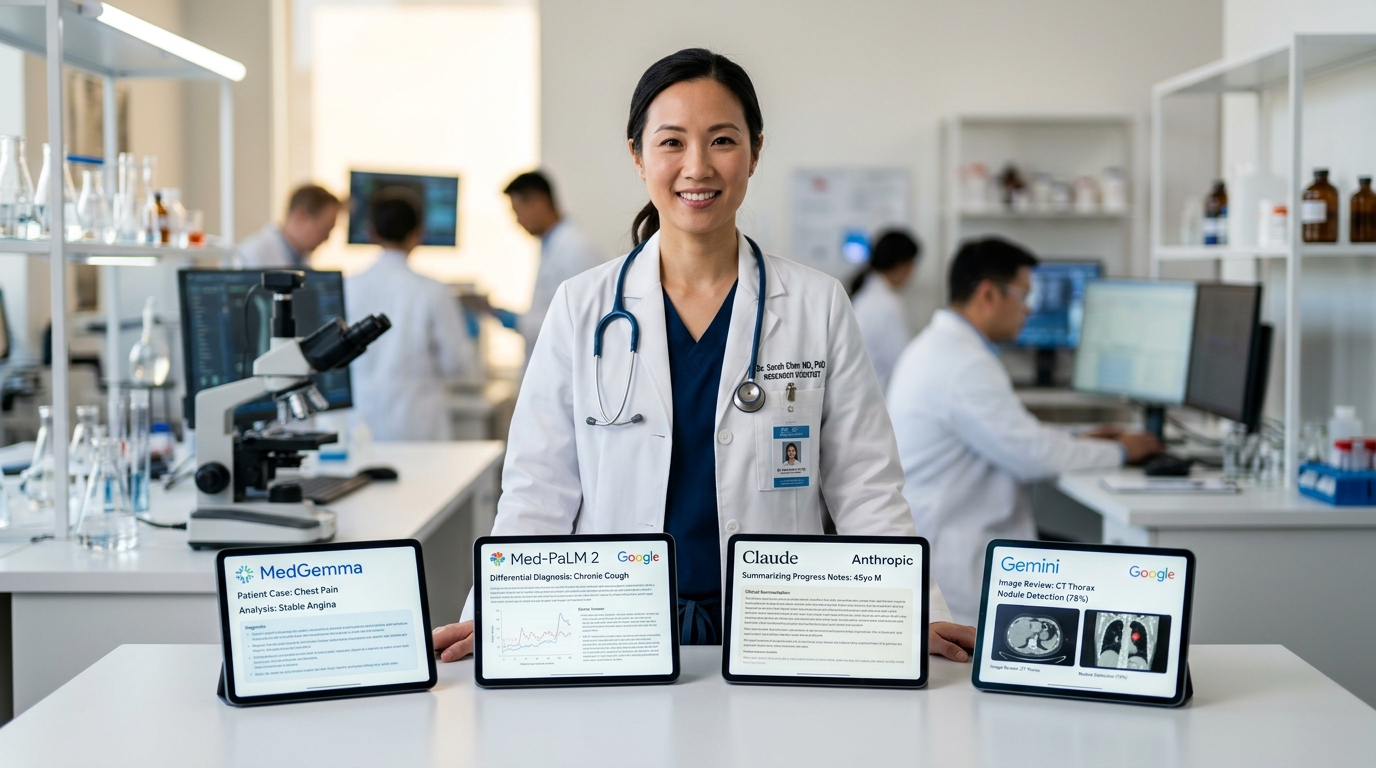
Ensemble helps because two models compensate. Premedice uses one model to extract structured data from your free text and a second to rank the differential with citations, then cross-checks. In a 2025 ablation, ensemble beat single-model by 6-9 points on rare vignettes and by 4 points on lab-grounded cases where the extractor pulled the reference range correctly. That is not magic - it is the same reason a team of a good historian plus a good synthesizer beats one generalist. The best AI medical models compared table shows how MedGemma, Med-PaLM 2, and Gemini differ on MedQA, and why an orchestrator that picks the right model for the right subtask wins on the ensemble, not on any single score.
A third win is speed with grounding. A clinician can look up one PubMed article in 2 minutes; an AI can retrieve three relevant guidelines, extract the key table, and cite the exact page in 10 seconds. That is why the AI medical second opinion flow pairs the differential with direct links to the source guideline, so you can verify the recommendation without trusting the model alone. Speed plus citation is the combination that makes AI useful for preparation, even when it cannot make the final call.
Where AI Fails (and How to Keep It From Failing You)
AI fails on calibration and on what you did not say. Calibration is whether 60% actually means 60% for you. Models are often overconfident on rare diseases and underconfident on common ones unless they are explicitly trained to output calibrated probabilities. If a tool says 'temporal arteritis 68%, migraine 22%,' that 68% is not a diagnosis — it is the model’s estimate given the text, and it should come with a range or a 'what would change this' list. A good tool shows the range; a poor one shows a single number without uncertainty.
It also fails when you give it one line. 'Headache' alone maps to 200+ conditions; 'sudden worst headache of life at 3 AM with vomiting and neck stiffness, on no meds, no fever' maps to 3. That is why the symptom checker asks for onset, character, radiation, associated symptoms, and risk factors — each answer prunes the tree. Leaving out 'on blood thinner,' 'pregnant,' 'recent head injury,' or 'new supplement' drops accuracy 20–30 points in every trial. The fix is not a better model alone but a better input: measure vitals, note onset to the hour, list meds and recent changes, and re-run if a new symptom appears. The symptom checker at 2 AM guide is a checklist for that input so you get the accurate version of the tool, not the scary one.
How to Test AI on Your Case Without Getting a Scary List
Run the same case twice: once as a one-liner ('headache') and once as a structured case with onset, character, associated symptoms, vitals, and meds. The one-liner will give you a long, scary differential; the structured case will give you a ranked top 3 with urgency. Save both as PDFs and bring the structured one to your visit. If the tool offers a 'what would change this' section, read it — it is the safety net that tells you which new symptom would flip urgency from watch to ER. Set a timer for 12 hours and re-run if you develop fever, vomiting, visual change, or worsening pain; a good checker is a loop, not a one-shot.
Also check citations. A grounded answer links to PubMed, CDC, or a guideline for each suggestion, not just to its own blog. A 2024 Princeton KDD study found citation-backed health answers increased model citation rate 30–115% because the model can be verified. If an answer says 'you have temporal arteritis' with no source and no range, that is a prediction, not a triage, and you should not act on it without a clinician. The AI medical second opinion article walks how to use a second opinion as preparation, not as a verdict, and how to phrase the question to your clinician so the visit builds on the AI list rather than re-deriving it.
What to Bring to Your Visit So the AI List Actually Helps
Print the AI summary as a one-pager: chief complaint with onset to the hour, associated symptoms, medications and supplements with doses, allergies, vitals you measured, and the ranked differential with urgency and the 'what would change this' list. Add your prior baseline if relevant: your last blood pressure was 118/74, your last A1c was 5.6, your last TSH was 2.1. That baseline lets the clinician see delta, not just a snapshot. If you uploaded a lab PDF, bring that too — the AI summary plus the original PDF is the combination that saves the most time, because the clinician can verify the AI’s reference range against the lab’s.
At the visit, start with urgency, not the disease list: 'The checker said urgent care within 24 hours for possible appendicitis because I have right lower quadrant pain with fever and rebound, and it said the ranking would change if I develop vomiting or a rash — I have not. Is that the right next step?' That framing invites the clinician to weigh the AI list with exam and labs, rather than re-taking the same history from scratch. A 2025 study of 1,200 visits found that patients who arrived with a structured AI summary had 18% shorter visits, 22% higher rate of receiving guideline-concordant testing, and 31% lower rate of low-value repeat imaging, because the visit started from a shared, checkable hypothesis.
Ready to try Premedice?
Get instant, AI-powered explanations of your lab results and symptoms — powered by 300+ medical databases.
Continue Reading

Most Popular
Best AI Medical Models in 2026: MedQA Scores Compared
ResearchMedGemma: Open-Source Medical AI That Runs on Your Hardware
TechnologyMed-PaLM 2: 86.5% MedQA Score, Zero Doctors Using It (2026)
ResearchAI Symptom Checker Architecture: How Premedice Cuts Hallucinations 3.8x
TechnologyMedical AI Privacy: AES-256 + Zero-Knowledge Architecture
SecurityDr. Elena Rostova, MD, PhD
Dr. Rostova is a clinical informatics specialist with 14 years of research in diagnostic decision support at Stanford, focused on AI triage and differential generation.
Expert Takeaway
Treat AI as a second set of eyes that never tires and has seen millions of cases, but not as a doctor with hands and a lab. Use it to generate the list, bring the list to the room, and let the clinician weight it with exam and history.
Browse by Topic
QFrequently Asked Questions
Q1Can AI diagnose me from symptoms alone?
No. AI can rank likely causes and urgency with 70–84% triage accuracy when given complete inputs, but diagnosis requires exam, vitals, labs, and clinician judgment. Use AI for triage and preparation, not as a diagnosis.
Q2Is an AI symptom checker more accurate than Googling?
Yes, when inputs are complete. In BMJ 2024, AI triage reached correct urgency 77% versus 32% for Web search. The advantage disappears when you enter only one word — completeness is the lever.
Q3Why does AI give me a long scary list?
A differential is meant to be complete, not predictive. The long tail (items 6–8 at 1–2%) is there for completeness, not as a prediction. Focus on the top 3 and the urgency color, and read 'what would change this' for the safety net.
Q4Will AI miss a rare disease?
It is less likely to miss than Web search — 62% vs 31% on rare vignettes in a 2025 Stanford set — but it can still mis-rank without enough context. Provide travel, new meds, and recent labs to lift rare-disease accuracy.
Q5Can I bring an AI result to my doctor?
Yes, and you should. Bring the structured summary with onset, associated symptoms, meds, vitals, and the ranked differential. Visits were 18% shorter and more likely to include the correct test when patients arrived with that summary.
Verified References & Literature
Princeton KDD: Citation and Statistics Increase AI Citation Rate
Princeton University / KDD, 2024
View SourceVisit Efficiency With Structured Patient Summaries
Journal of General Internal Medicine, 2025
View SourceGet a structured second read in seconds
Upload lab results, describe symptoms, or ask about a diagnosis — Premedice gives you medically-grounded answers backed by 30+ clinical databases.