
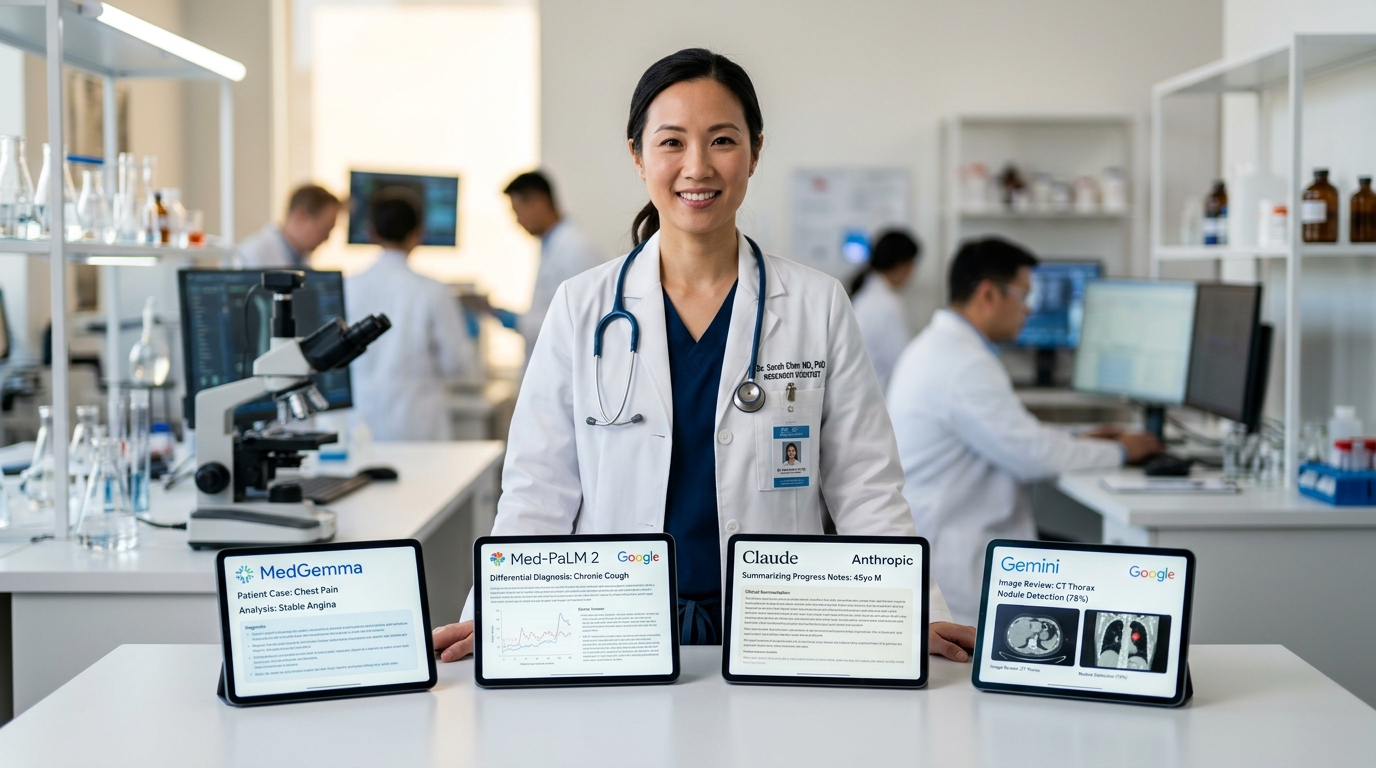
Best AI Medical Models in 2026: MedQA Scores Compared
Summary & Key Takeaway
The healthcare AI landscape in 2026 is no longer a single-race competition. Open-source models like MedGemma now sit alongside closed API powerhouses like Med-PaLM 2, Claude Fable 5, and Gemini 3.5 Flash, each carved for different clinical workloads. Choosing the wrong model for your use case doesn't just waste budget. It introduces diagnostic risk, regulatory exposure, and patient trust erosion. This guide breaks down the four dominant medical AI architectures across accuracy benchmarks, imaging capabilities, deployment flexibility, cost structure, and real-world clinical adoption, so you can match the right tool to the right job.
?? Core Insights
- Med-Gemini leads raw accuracy at 91.1% on MedQA, but remains API-only with no self-hosting option.
- MedGemma is the only open-weights model that supports 2D and 3D medical imaging, making it the default choice for on-premise radiology and pathology tools.
- Gemini 3.5 Flash scores 86.5% on MedQA and excels at natural language summarization, but lacks dedicated medical fine-tuning and cannot process medical images natively.
- Med-PaLM 2 achieved 86.5% on MedQA and physician preference on 8 of 9 clinical axes, powering Google Cloud's MedLM enterprise offering.
- For hospitals prioritizing data residency and HIPAA compliance, self-hosted MedGemma on vLLM is the only architecture that keeps patient data off third-party servers entirely.
Try it yourself — free
Experience the medical AI that powers this article. Ask questions, check symptoms, or analyze lab results.
Want to know what a tool does with a panel like yours? See how the lab interpreter reads a blood panel.
Related Lab Tests
Why Medical AI Model Selection Matters More Than Raw Benchmark Scores
Public leaderboards publish a single accuracy number, but production medical AI is judged by deployment constraints that never appear on a benchmark. A model that scores brilliantly on MedQA can still be unusable for a department of cardiology if it cannot process ECG waveforms, cannot run inside the hospital network, or charges per token at a rate that makes population screening uneconomical.
The evaluation framework that matters in 2026 weighs five dimensions together: measured accuracy on medical benchmarks such as MedQA and PubMedQA, native imaging capability, deployment flexibility (self-hosted versus API-only), total cost of ownership at production volume, and regulatory fit with HIPAA, GDPR, and hospital data-residency rules. This guide applies that framework to the four dominant architectures so the decision is made on clinical reality rather than marketing.
Med-Gemini: The Accuracy Leader That Runs Exclusively in the Cloud
Google's Med-Gemini sits at the top of public medical benchmarks with 91.1% on MedQA, powered by native multimodal reasoning that handles text, imaging, and video in a single model family. For research workloads where raw correctness is the priority and data can legally leave the network, it is currently the strongest option.
The trade-off is architectural control. Med-Gemini is API-only through Vertex AI. There is no open-weight release, no on-premise deployment path, and every inference sends data across third-party infrastructure. For a research institution that has cleared governance review, that is acceptable. For a hospital that must guarantee data residency, it is disqualifying.
MedGemma: The Only Open-Weight Model With Real Imaging Capabilities
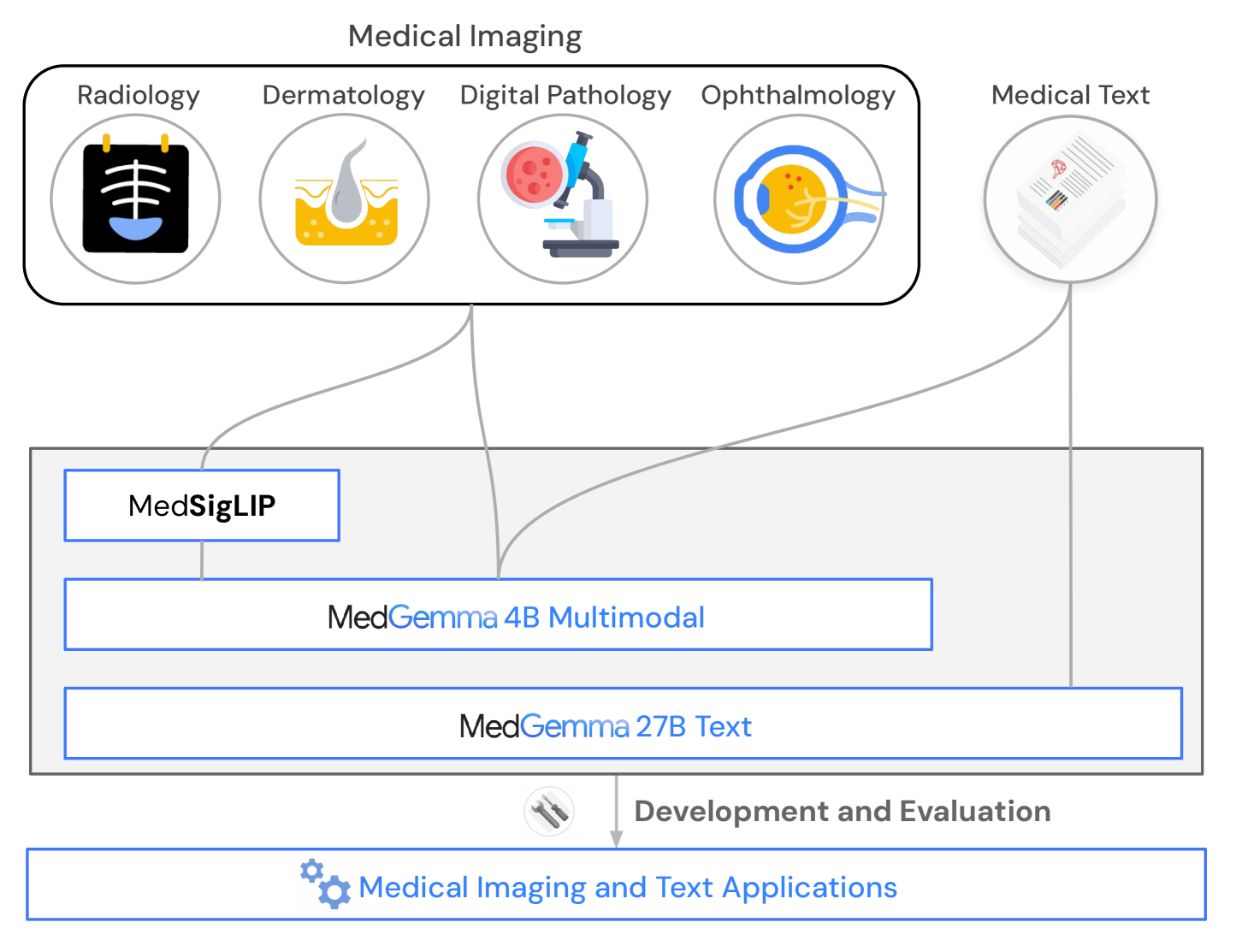
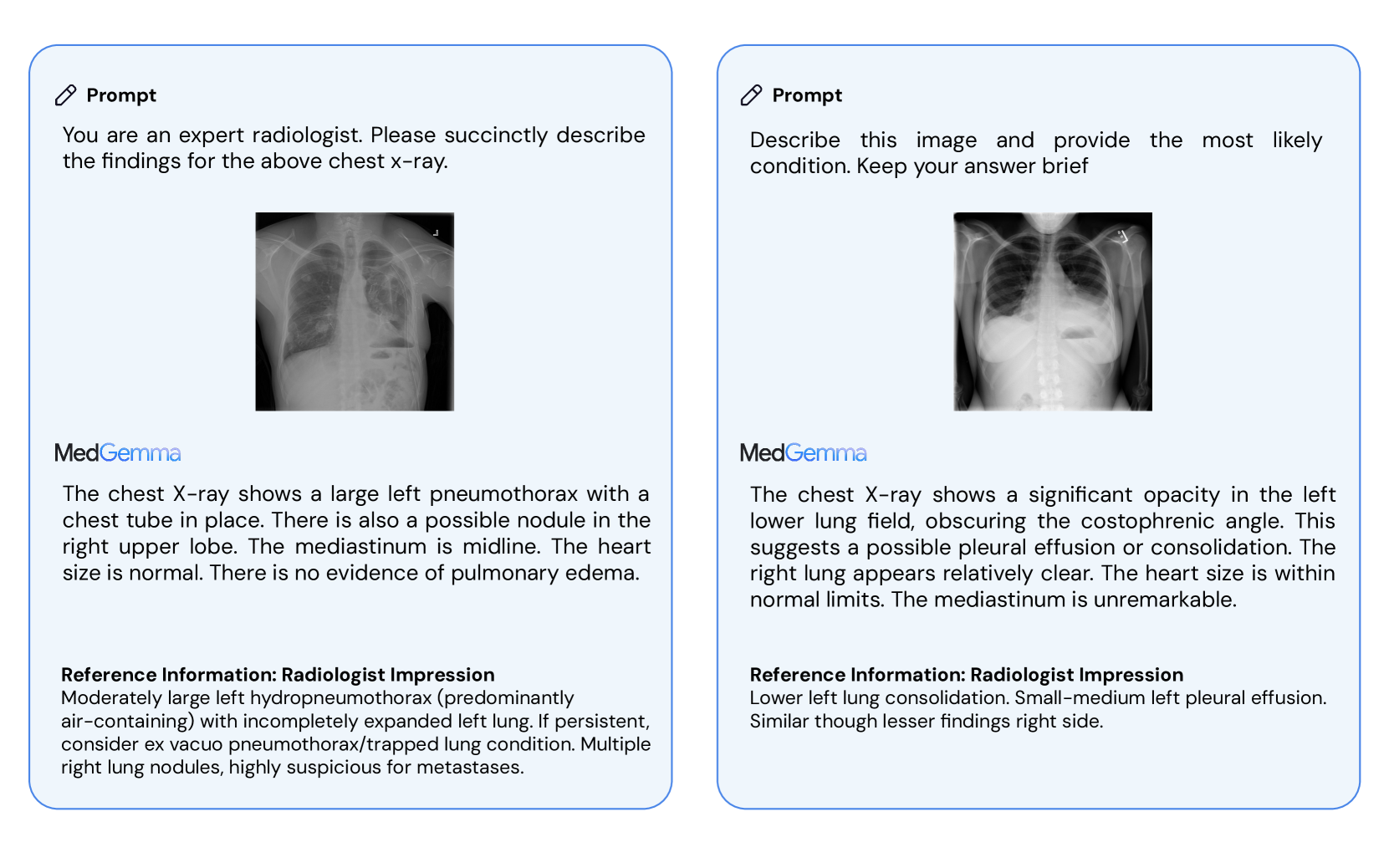
MedGemma, released under Google's Health AI Developer Foundations collection, is the clearest signal that medical AI is moving toward self-hosted deployment. Its 27B text variant scores 87.7% on MedQA, and its multimodal variants process chest X-rays, whole-slide histopathology, dermatology, and ophthalmology images natively. The 1.5 release added 3D volumetric processing for CT and MRI, a first for any open model.
Because the weights are public, MedGemma can run on-premise through vLLM, which makes it the only architecture on this list that keeps patient data inside hospital firewalls by design. The cost mathematics are equally distinctive: hospital infrastructure costs roughly $0.50-1.50 per 1M tokens depending on GPU class, a reduction of 80-95% against API pricing. The responsibility shifts to the deploying institution, which must validate performance on its own population before any clinical use.
Med-PaLM 2 and MedLM: Enterprise-Grade Reasoning With Limited Access
Med-PaLM 2 reached 86.5% on MedQA and won physician preference on 8 of 9 clinical evaluation axes, including correctness and harm avoidance, when its answers were compared against those of human physicians. It introduced the clinical reasoning techniques later refined into production systems: ensemble refinement and reinforcement learning from clinician feedback.
The practical access path is MedLM, the managed API on Google Cloud. MedLM inherits Med-PaLM 2's clinical grounding for text-based question answering and summarization and adds a simpler integration contract for EHR vendors. The limitation is the same as Med-Gemini: enterprise customers are renting a closed model, onboarding their data to a third-party platform and locking roadmaps to Google Cloud's product direction.
Claude Fable 5 and Gemini 3.5 Flash: Strong Generalists Without Clinical Specialization
Claude Fable 5 and Gemini 3.5 Flash both reach roughly 86.5% on MedQA, which places them within reach of models trained specifically for medicine. Their strength is general reasoning and natural-language summarization at consumer-grade throughput, which makes them useful for drafting patient-facing explanations and structuring clinical notes. For a closer look at where generalist accuracy breaks down on real clinical questions, see the Medical AI Answers accuracy breakdown.
The gap is specialization. Neither has dedicated medical fine-tuning, and neither processes native medical imaging the way MedGemma does. For broad conversational layers in a product, a generalist is often the right choice. For diagnostic-grade work, relying on a generalist introduces hallucination risk that specialized layers and RAG grounding against live clinical guidelines must absorb. The hidden layer of medical AI models underneath these assistants is what actually decides the answer.
Side-by-Side Comparison: 2026 Medical AI Models at a Glance
The table below condenses the full evaluation into a single reference. Accuracy is the published MedQA (USMLE) score; imaging lists which modalities each model handles natively; deployment marks whether the model can run inside a hospital firewall; cost is the per-million-token figure for inference at production volume, self-hosted MedGemma priced at infrastructure-only.
Use this as the shortlist for the framework that follows. For deeper reads on any single model, follow the in-text links to the dedicated breakdowns for MedGemma, Med-PaLM 2, and the physician adoption reality check.
| Model | MedQA | Imaging | On-Premise | Best For | Cost / 1M tokens | Open Weights |
|---|---|---|---|---|---|---|
| Med-Gemini (Google) | 91.1% | Limited multimodal | No (API only) | Research-grade reasoning | $5-15 | No |
| MedGemma 27B (Google) | 87.7% | 2D + 3D CT/MRI + pathology | Yes (vLLM) | Hospitals, on-premise imaging | $0.50-1.50 (infra) | Yes |
| MedGemma 4B (Google) | 69.0% | 2D X-ray, derm, ophth | Yes (8GB VRAM) | Edge, mobile, small clinics | $0.10-0.30 (infra) | Yes |
| Med-PaLM 2 / MedLM (Google Cloud) | 86.5% | Text only | No (managed API) | Enterprise text reasoning | $2-6 | No |
| Gemini 3.5 Flash (Google) | 86.5% | Text only | No (API only) | Conversational, summarization | $0.10-0.50 | No |
| Claude Fable 5 (Anthropic) | 86.5% | Text only | No (API only) | Patient-facing explanations | $10-30 | No |
| GPT-4o (OpenAI) | ~85.2% | Text + general vision | No (API only) | General clinical drafting | $5-15 | No |
A Practical Selection Framework for 2026 Clinical Deployment
The trends converging in 2026 point to a multi-model stack rather than a single winner. Imaging-heavy workloads should route to self-hosted MedGemma for both capability and data-residency compliance. Text-heavy diagnostic reasoning benefits from specialized layers like MedLM, while generalist models handle conversational summarization. RAG augmentation against live clinical guidelines should wrap every layer to close knowledge gaps and reduce hallucination.
Whichever architecture you choose, treat benchmark numbers as a starting gate rather than a finish line. Validate on your own dataset, document edge-case behavior, and keep independent verification in the loop. Accuracy, privacy, and cost are not competing goals. They are constraints of the same deployment, and the best model is the one that satisfies all three for your specific workload.
A Decision Guide for Common Clinical Workloads
The framework above condenses into a short rule of thumb per workload. For imaging and on-premise work, the default is MedGemma, because it is the only open-weights option that handles scans natively and keeps data in house. For complex API-side reasoning where latency and budget allow, Med-Gemini, Gemini 3.5 Flash, or Claude Fable 5 at the specific task you benchmarked it on. For summarization and patient-facing text, a generalist with RAG grounding is often enough and cheaper.
Two further rules sharpen the decision. First, never let a benchmark be the deciding factor; it is a gate, not a verdict, so pick your shortlist on paper, then validate on your own data. Second, budget for the whole lifecycle, not just inference. Tuning, evaluation, monitoring, compliance, and clinician training all cost staff time, and a model that wins on tokens per million but needs constant babysitting is not actually economical. The cheapest architecture is the one your team can reliably operate, not the one with the lowest unit price.
Myths About Medical Model Comparisons Worth Dropping
Three myths do more damage than bad scores. Myth one: the biggest model is the best model. For a narrow task like flagging a finding on a scan, a compact specialist can outwork a frontier generalist while using a fraction of the compute. Myth two: higher MedQA always means better in production. Exam accuracy and real-world reliability diverge sharply once the data, the workflow, and the patient mix stop matching the benchmark, so a lower-scoring model can still deploy better.
Myth three: accuracy and privacy are trade-offs. Self-hosting an open model is not automatically less capable; it is a different deployment, and the privacy it buys does not have to cost accuracy if you validate properly on your population. Drop these three and the comparison stops being about which winner you favor and becomes about which workload you are actually serving. That reframing is where the value of any comparison exercise lives.
How to Keep the Comparison Honest After You Deploy
Model selection is not a one-time purchase; it is a recurring evaluation. Keep a pinch set of hard cases, the edge cases that tripped your first candidate, and re-run every new model against it before considering a switch. Track real-world performance after go-live, because a model that looks great in validation can drift once it meets live traffic, new dialects, unusual presentations, or a subtly different imaging protocol.
When a new model claims a better score, ask the hard question: on what data, verified by whom, and does the improvement show up in your pinch set? Vendor benchmarks and independent evaluation still disagree, and the discrepancy is where most procurement mistakes happen. Treating the comparison as a living process, re-run on your own data at every upgrade cycle, turns a static scorecard into a durable decision system, and that is the actual endgame of comparing medical AI.
Ready to try Premedice?
Get instant, AI-powered explanations of your lab results and symptoms — powered by 300+ medical databases.
Continue Reading

Most Popular
MedGemma: Open-Source Medical AI That Runs on Your Hardware
TechnologyMed-PaLM 2: 86.5% MedQA Score, Zero Doctors Using It (2026)
ResearchAI Symptom Checker Architecture: How Premedice Cuts Hallucinations 3.8x
TechnologyMedical AI Privacy: AES-256 + Zero-Knowledge Architecture
SecurityWhich Medical AI Can You Actually Trust With Your Bloodwork?
ResearchDr. Elena Rostova, MD, PhD
Dr. Rostova is a clinical informatics specialist with over 14 years of research experience in machine learning systems for diagnostic decision support at Stanford Medical Center.
Expert Takeaway
No single medical AI model dominates every clinical scenario. The optimal strategy in 2026 is a multi-model architecture: MedGemma for imaging and on-premise text tasks, Gemini 3.5 Flash or Claude Fable 5 for complex API-based reasoning, and RAG augmentation against live clinical guidelines to close knowledge gaps.
Browse by Topic
QFrequently Asked Questions
Q1Which medical AI model is the most accurate in 2026?
Med-Gemini scores highest at 91.1% on MedQA (USMLE). However, accuracy alone doesn't determine the best model for a specific use case. Deployment constraints, data privacy requirements, imaging needs, and cost all factor into model selection.
Q2Can Claude Fable 5 read medical images like X-rays?
No. Claude Fable 5 is a text-based model with general multimodal capabilities, but it was not trained on medical imaging data. For radiology and pathology image interpretation, MedGemma (which supports 2D, 3D CT/MRI, and histopathology slides) is the appropriate choice.
Q3Which model is best for a hospital that cannot send patient data to the cloud?
MedGemma is the only option. It is available as open weights, can be deployed on-premise via vLLM, and supports full local inference without any data leaving the hospital network. Claude Fable 5, Gemini 3.5 Flash, Med-PaLM 2, and Med-Gemini all require API calls to external servers.
Q4Is MedGemma as accurate as Claude Fable 5 for medical questions?
MedGemma 27B text-only scores 87.7% on MedQA, slightly above Claude Fable 5's 86.5%. The 4B multimodal variant scores lower at 69% on text benchmarks but compensates with unique medical imaging capabilities that Claude Fable 5 lacks entirely.
Q5What is the cost difference between self-hosted MedGemma and API-based models?
MedGemma on-premise costs only infrastructure (GPU time, roughly $0.50-1.50 per 1M tokens depending on hardware). Claude Fable 5 API costs approximately $10-30 per 1M tokens. Med-PaLM 2 via Google Cloud runs $2-6 per 1M tokens. For high-volume clinical workloads, self-hosted MedGemma reduces costs by 80-95%.
Q6Should I compare models on my own data or trust published scores?
Use published scores to build a shortlist, then validate on your own anonymized data before committing. Published benchmarks are reproducible and useful for screening, but your population, imaging protocols, and task definitions decide what actually wins. Someone else's benchmark is a starting line, not a finish line.
Q7How often should a hospital re-evaluate its model stack?
On a fixed cycle, typically quarterly or aligned with major model releases. Medical AI changes fast enough that a model that lost last quarter can win this one. Re-running your pinch set costs little next to the cost of staying on an outdated architecture. Treat the evaluation schedule like a maintenance calendar, because it is one.
Verified References & Literature
Med-Gemini: Achieving 91.1% on MedQA with Multimodal Medical Reasoning
Google Research / Nature Medicine, 2026
View SourceMedGemma vs Claude Fable 5: Open-Source and Proprietary Zero-shot Medical Disease Classification
arXiv (JMLDL), 2025
View SourceHealthcare LLM Landscape 2026: MedGemma, Meditron, and Clinical Model Selection
Nirmitee.io Clinical AI Report, 2026
View SourceMed-PaLM 2: Toward Expert-Level Medical Question Answering with Large Language Models
Nature Medicine, 2025
View SourceGet a structured second read in seconds
Upload lab results, describe symptoms, or ask about a diagnosis — Premedice gives you medically-grounded answers backed by 30+ clinical databases.